The room itself
Inside the Mirror Chapel
What the Mirror Chapel holds: the mirrors that give it its name, a ceiling fresco from 1723, two Baroque organs and a history as a concert hall.
Reserve your seat in the chapel ↗Built between 1722 and 1726
The chapel was built between 1722 and 1726 at the expense of the Latin Major Marian Sodality, and it was first consecrated to the Annunciation of Our Lady. The architect isn't known for certain: František Maxmilián Kaňka and Kilian Ignaz Dientzenhofer are the two names most often put forward. It stands on the ground floor of the Klementinum, in a wing in the fourth courtyard that joins the Astronomical Tower to the northern wing of the old college.
Why it is called the Mirror Chapel
The chapel took its present name from the unusually extensive use of mirrors in its decoration. They are set into the walls and across the vault, where they catch the light and repeat the gilt around them. With gilded stucco, marble, frescoes and paintings, the interior is a dense combination of materials. The National Library calls the chapel one of the greatest treasures of the Klementinum, and describes the room as richly designed from floor to vault.
The ceiling and the paintings
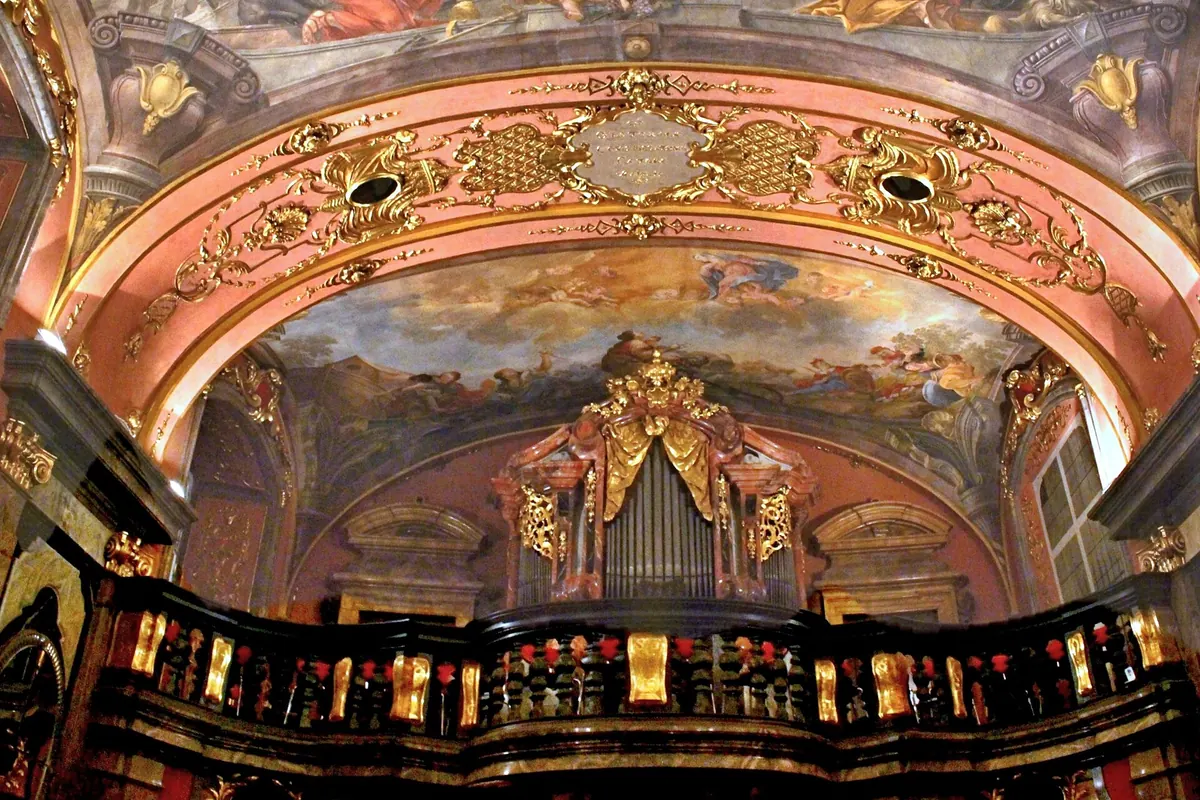
A five-part fresco covers the ceiling, painted in 1723 by Jan Hiebel and inspired by the Marian prayer Ave Maria. Four oil paintings by Václav Vavřinec Reiner follow the same theme, tied to the Annunciation and the life of the Virgin Mary. Look up as you take your seat, because the ceiling is easy to forget once the music begins. The fresco is divided into five parts, so it rewards a few slow glances across the vault rather than one long stare.
Two Baroque organs
The chapel holds a pair of Baroque organs. The original, in the organ loft, dates from about 1732 and is attributed to the Jesuit organ builder Tomáš Schwarz. The second comes from the church in Svatobor near Doupov, and was installed in the 1950s on the spot where the main altar had stood until its loss after the secularisation of 1784. Between them they fill both ends of a small room, one above the seats and one where the altar once was, so the instruments are part of its decoration as well as its sound.
Where to look from your seat
Photographs of the room show a lot to take in. The choir loft has a black and gold balustrade, and the organ stands above it against a painted vault. Gilded stucco frames the ceiling, white angels sit near the corners, and a patterned stone floor runs between the rows. Start with the ceiling, then the loft, then the second organ behind the musicians. The mirrors are easiest to notice when the light shifts, so glance at the walls during a quiet passage, not a loud one.
From chapel to concert hall
Since the mid 1930s the chapel has served secular purposes: regularly as a concert hall, and occasionally for exhibitions. Today it is also rented for events such as ceremonies and weddings. The National Library lists it at 170 seats and describes it as heated to about 18 degrees Celsius for events. The chapel is open only during events, which is why a concert is the usual way to see inside it, and why the concert is a reason to visit in its own right.
The entrance and the bust of Mozart
The chapel is entered through a Classicist annexe designed by Matthias Hummel, whose construction restored the structural integrity of the wing. In the antechamber stands an over-life-size bust of Mozart by Emanuel Max. Mozart first visited the Klementinum on 13 January 1787 and returned several times, so the bust points to a real connection, not just a decoration. It is worth a look on your way in, while the room is still filling and the musicians are settling.
Sources